






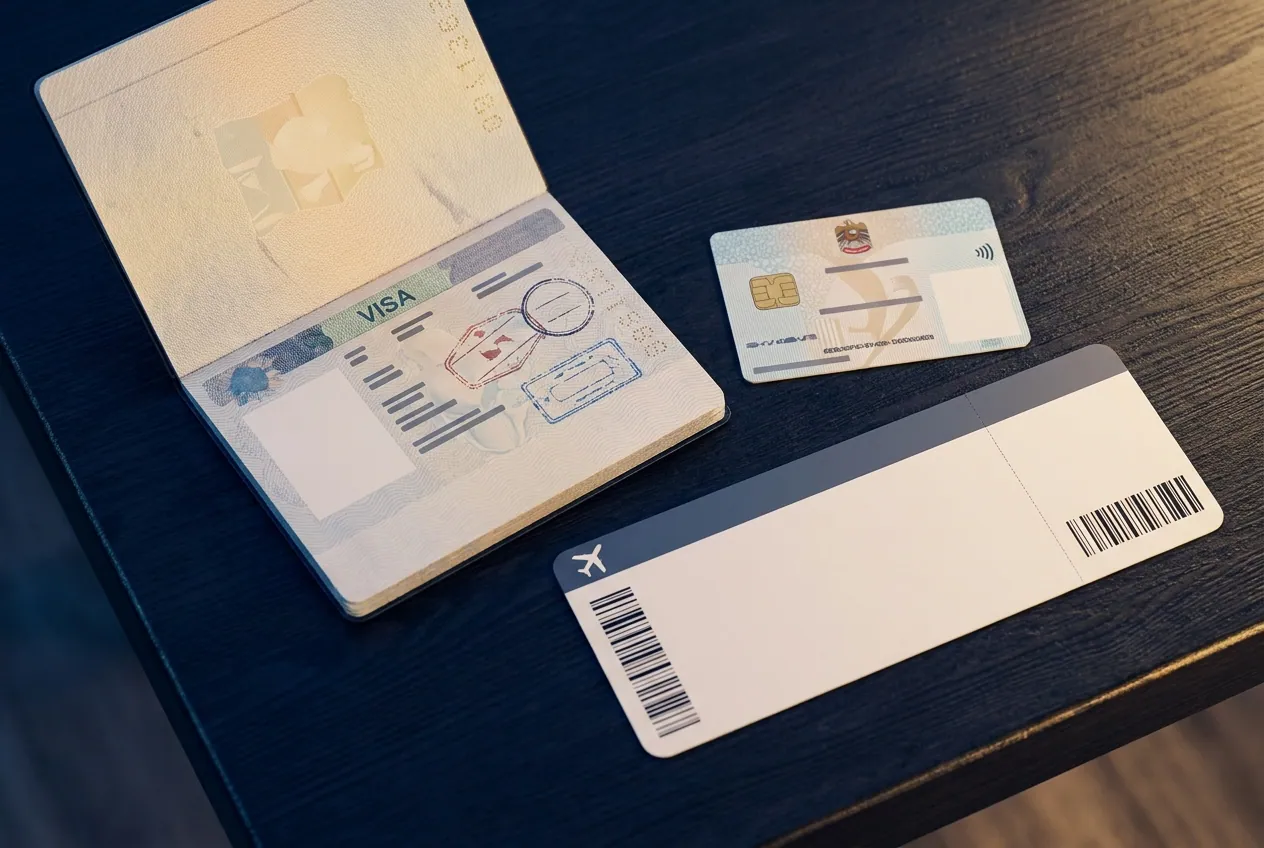
UAE Visas and Residency Explained
A clear map of every main UAE visa type, from visit and transit visas to employment, family, Golden, Green, retirement, remote work and student residency.
Last reviewed 21 Oct 2026
The United Arab Emirates offers more ways to live, work and visit than almost any other country in the region. The right visa depends on why you are coming, how long you plan to stay and who is sponsoring you. This guide explains each main category in plain language, who handles it, and what to watch for with renewals and grace periods.
Rules and fees are updated regularly. The figures below are accurate as of 2026, but always confirm on the official sites of the Federal Authority for Identity, Citizenship, Customs and Port Security (ICP) or, for Dubai, the General Directorate of Residency and Foreigners Affairs (GDRFA).
Who issues what
| Authority | Role |
|---|---|
| ICP (federal) | Issues most visas and Emirates IDs across the UAE, runs the ICP smart services and app |
| GDRFA Dubai | Handles residency and visit visas for the emirate of Dubai |
| MOHRE | Issues work permits and regulates employment contracts for mainland private sector staff |
| Free zone authorities | Issue residency linked to a free zone company licence |
| Airlines and airports | Check visa status and permitted stay before you board |
In practice most people use an app (ICP, GDRFA or their free zone portal) or an authorised typing centre, and employers usually manage the paperwork for staff.
Visit and tourist visas
Visa on arrival and visa-free entry
Citizens of a long list of countries, including the UK, most of the EU, the US, Canada, Australia, Japan and others, receive a visa on arrival at UAE airports. The permitted stay is typically 30 or 90 days depending on nationality, and in some cases it can be extended. Citizens of some GCC and other states enter on different terms. Eligibility lists change, so check with your airline or the ICP before you travel.
Pre-arranged tourist visas
If your nationality needs a visa in advance, you apply through an airline, hotel, licensed tour operator or sponsor.
- 30-day tourist visa, single entry, extendable once.
- 60-day tourist visa, single entry, extendable once.
- 5-year multi-entry tourist visa. You can enter many times, with each stay of up to 90 days, extendable by a further 90 days within a year. Applicants usually need to show a bank balance of around USD 4,000 (or its dirham equivalent) over the previous six months, and valid health insurance.
Visit visa for family and friends
A resident can sponsor a relative or friend as a visitor. The sponsor needs a valid residence visa and a deposit may be asked of the guest.
Transit visas
Transit visas are short-stay permits for travellers connecting through the UAE. They are typically valid for 48 or 96 hours and are arranged through the airline you are flying with.
Overstaying
Overstaying a visit or residence visa results in daily fines. Use the overstay fine calculator to estimate the amount, and leave or extend before the visa ends.
Employment residence visa
This is the most common route for expats. The process runs in a fixed order.
- Job offer and contract. Your employer applies for a work permit through MOHRE (or its free zone authority).
- Entry permit. You receive it by email and use it to enter the UAE.
- Status change. If you are already in the country as a visitor, your sponsor converts your status without you leaving.
- Medical fitness test. A blood test and chest X-ray at an approved centre.
- Emirates ID biometrics. Fingerprints and a photo.
- Visa stamping. The residence visa is issued and linked to your Emirates ID.
Residence visas for employees are typically valid for two years, and some free zone visas run for one to three years. See our moving checklist for the full first-weeks plan, and working in the UAE for your contract rights.
Family sponsorship
Residents can sponsor their spouse, children and in some cases parents.
Salary thresholds
- The standard requirement for sponsoring family is a monthly salary of at least AED 4,000.
- Alternatively, AED 3,000 per month plus company-provided or free accommodation is accepted.
- Higher requirements usually apply for sponsoring parents. They are often assessed individually and tied to income, accommodation size and health insurance.
Documents
You generally need your passport, Emirates ID, attested marriage certificate for a spouse, attested birth certificates for children, a tenancy contract registered with the local authority (Ejari, Tawtheeq or similar), and proof of salary. Health insurance for each dependant is required. Sons can usually be sponsored to age 18, with extensions possible for students, while daughters can be sponsored without an upper age limit until marriage.
Women who are residents can sponsor their families on the same terms, a rule that was liberalised some years ago.
Long-term residency
Golden Visa (10 years)
The Golden Visa is a long-term residence permit that does not require a sponsor and renews automatically while you meet the criteria. It is designed for:
- Investors, including those buying property worth at least AED 2 million (rules vary by emirate and ownership structure).
- Entrepreneurs with approved projects.
- Specialised talents such as doctors, scientists, inventors and artists.
- Executives and highly skilled professionals earning at least AED 30,000 per month.
- Outstanding students and graduates, and frontline heroes.
Golden Visa holders can sponsor immediate family and domestic workers with fewer restrictions. Try the Golden Visa checker for a quick eligibility check.
Green Visa (5 years)
The Green Visa is a five-year permit for people who do not need an employer sponsor. It covers:
- Skilled workers with a qualifying job in skill levels 1 to 3, a relevant bachelor's degree or diploma, and a salary of at least AED 15,000 per month.
- Freelancers and self-employed people with a freelance permit and the required qualification or income.
- Investors and partners with a qualifying business stake.
Green Visa holders have a longer grace period after leaving a job or cancelling the visa than regular employees.
Retirement visa (5 years)
People aged 55 or over can apply for a five-year retirement visa. The requirements usually involve one of three conditions: owning property worth at least AED 1 million, holding savings of at least AED 1 million, or proving a monthly income of at least AED 20,000. It is renewable.
Remote work visa (1 year)
The Virtual Working Programme visa lets you live in the UAE while working for an employer or company abroad. You typically need proof of a one-year employment contract or company ownership, a monthly income of about USD 3,500, a valid passport and health insurance valid in the UAE.
Student visa
Students at UAE universities are sponsored by the institution, and the visa is usually valid for one year and renewable while you study. Some outstanding students qualify for a Golden Visa. See the schools and education guide for universities and scholarships.
Emirates ID
The Emirates ID is a mandatory card for every resident. It holds your biometric data and is your key to banking, health services, utilities and government portals. You apply for it as part of the residence visa process. It is valid for the same duration as your visa, and it is renewed through the ICP app or kiosks. Carry it, or its digital copy in UAE PASS, at all times. Link it with the UAE PASS app for secure digital access.
Renewals, cancellation and grace periods
Renewal
Start the renewal at least 30 days before expiry. Employers usually do this for staff, and the process mirrors the original one but without a new entry permit. A new medical test may be required.
Cancellation
When you leave a job, your employer cancels your work permit and residence visa. You can also cancel if you are leaving the country for good. Always collect proof of cancellation before leaving.
Grace periods
After a visa is cancelled or expires, you generally have a limited grace period to leave, change status or find a new sponsor, commonly around 30 days for most residents, and longer for Golden and Green Visa holders. The exact period depends on your visa type, so confirm it on the ICP or GDRFA site, and move quickly, since fines begin immediately after the grace period ends.
Frequently asked questions
What is the minimum salary to sponsor my family?
AED 4,000 per month, or AED 3,000 per month if you also have company-provided or free accommodation. Sponsoring parents often needs a higher income and extra documents.
Can I switch from a visit visa to a residence visa without leaving the UAE?
Yes. Your sponsor applies for a status change, you take the medical test and give your Emirates ID biometrics, and the residence visa is stamped. You do not need to exit the country in most cases.
What is the difference between Golden Visa and Green Visa?
The Golden Visa lasts 10 years and targets investors, entrepreneurs, top talent and highly paid professionals. The Green Visa lasts five years and targets skilled workers, freelancers and self-employed individuals. Both are self-sponsored, and the Golden Visa has the higher thresholds.
How long can I stay in the UAE if my job ends?
Typically you have a grace period of around 30 days after your visa is cancelled. Holders of Golden and Green Visas get longer. Check your exact period on the ICP app before it runs out.
Is the 5-year tourist visa the same as residency?
No. It allows repeated visits of up to 90 days each, but you cannot work and you are not a resident. For long stays you need a residence visa, a Green or Golden Visa, a retirement visa or a remote work visa.
More questions
How long can I stay in the UAE on a visit visa?
Visa on arrival is 30 days for most eligible nationalities (90 days for some, including most EU citizens), extendable once. Pre-arranged visit visas come in 30 and 60 day versions. Overstaying costs AED 50 a day, so extend or leave before the date on your entry stamp or e-visa.
What is the grace period after my residence visa is cancelled?
Normally 30 days from cancellation or expiry to leave, change status or get a new visa. Some categories get up to 180 days. Visit visas have no automatic grace period under current rules.
Daleel UAE is a guide, not legal, financial or immigration advice. Rules change; confirm with the authority named before you act. Spotted an error? Tell us.