






Banking, Money and Tax in the UAE
How banking, credit, remittances and taxes work in the UAE, from opening an account to VAT, corporate tax, savings and investing.
Last reviewed 21 Oct 2026
The UAE is one of the easiest places in the world to bank and save, mainly because there is no personal income tax. But the financial system has its own rules on credit, cheques and borrowing that catch newcomers out. This guide explains the dirham, how to open and use an account, how credit works, which taxes apply, and where to save or invest. Figures are as of 2026, and the authorities named are the best place to confirm anything that changes, including the Central Bank and the Federal Tax Authority.
The dirham and the dollar peg
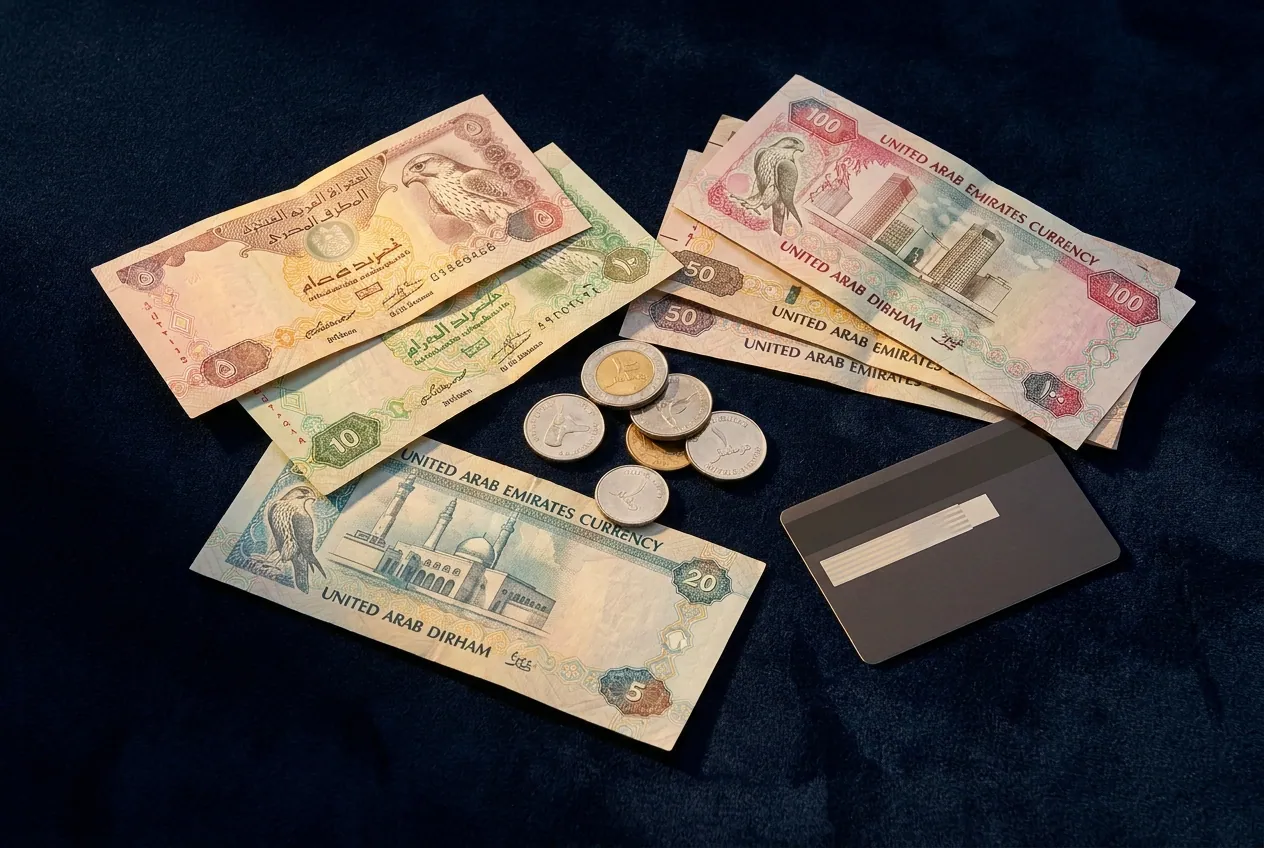
The UAE dirham (AED) has been pegged to the US dollar at about AED 3.6725 per USD since 1997. That means the dirham moves with the dollar against other currencies, so a falling or rising dollar affects what your salary is worth if you send money to the UK, India or Europe. Interest rates in the UAE also tend to follow US rates. Use our currency converter to compare.
Opening a bank account
All residents can open a personal account, and most employers pay salaries into one. You normally need:
- Your passport and residence visa
- Your Emirates ID
- A proof of address, such as a tenancy contract or utility bill
- A salary certificate or employment contract (for salary accounts)
Banks fall into three groups:
- Large local banks, such as Emirates NBD, First Abu Dhabi Bank, Abu Dhabi Commercial Bank, Mashreq, RAKBANK and Commercial Bank of Dubai.
- Islamic banks, including Dubai Islamic Bank, Abu Dhabi Islamic Bank and Emirates Islamic.
- Digital banks, including Wio, Liv and Mashreq Neo, where you can open an account in an app.
Many accounts require a minimum balance or charge a monthly fee if you fall below it. The amount ranges widely, from zero for basic digital accounts to several thousand dirhams for premium tiers. Compare the fees for dormant accounts, international transfers and ATM use.
Salary transfer
Employers must pay private-sector wages through the Wages Protection System run by MOHRE, which sends salaries to a UAE bank account. A salary transfer to a bank usually gives you better terms, such as a credit card or personal loan, but it also means the bank can claim any amount you owe if your job ends. Moving your salary to another bank often needs a new letter from your employer.
Cheques and payments
Cheques are still common for rent and deposits, though many payments now use bank transfers, cards and instant payment systems. Never issue a cheque you cannot cover. A cheque that bounces can lead to legal claims and, depending on the law in force and the circumstances, criminal complaints. Cash over AED 60,000 must be declared when you enter or leave the country.
Credit cards and the credit bureau
Credit cards are easy to get once you have a salary, usually with a minimum monthly income of around AED 5,000 to AED 8,000, but interest on unpaid balances is high, so pay the full statement amount each month.
Your credit record is held by the Al Etihad Credit Bureau (AECB), which scores individuals from 300 to 900. A higher score means better borrowing terms. To build a good record:
- Pay every instalment and card bill on time.
- Keep card balances well below your limit.
- Avoid applying for many cards or loans in a short period.
- Check your report from time to time through the AECB website or app, and correct any errors.
Unpaid debts can be reported and can affect your ability to renew a visa, get a mortgage or leave the country in serious cases.
Loans and the debt burden ratio
Under Central Bank rules, banks limit total monthly debt payments to 50 percent of your monthly income, known as the debt burden ratio. This covers all loans, card minimums and mortgages, and lenders check it in AECB records. Personal loans, car loans and mortgages need a clear income, and banks often prefer applicants with salary transfers. Compare the full cost, including processing fees, insurance and early-settlement charges, not just the stated rate. You can model repayments with our mortgage calculator.
Sending money home
Millions of residents send money abroad each month. Your main options are:
- Exchange houses, such as Al Ansari Exchange and LuLu Exchange, which are licensed by the Central Bank and are convenient for cash.
- Bank transfers, usually reliable but with higher fees and weaker exchange rates.
- Digital remittance apps, such as Wise and Remitly, which often give better rates.
Compare the exchange rate as well as the fee, because the rate is where most of the cost is hidden. Use only licensed providers and avoid informal channels.
Taxes in the UAE
Income tax
The UAE does not charge personal income tax on salaries, nor capital gains tax or inheritance tax for individuals. Individuals are taxed only if they run a business in their own name with annual turnover above AED 1 million. This is the main reason many people move here, though most still face tax obligations in their home country, so check your own position.
VAT
Value added tax of 5 percent applies to most goods and services. Some supplies are zero-rated, such as exports and qualifying education and healthcare, and others are exempt, including residential rent. Businesses must register if taxable supplies exceed AED 375,000 a year. Tourists can reclaim VAT on qualifying purchases at the airport. Use our VAT calculator.
Corporate tax
Corporate tax of 9 percent applies to taxable profits above AED 375,000, and profits below that are taxed at 0 percent. Qualifying free zone companies can enjoy 0 percent on qualifying income. A 15 percent minimum tax applies to very large multinational groups. All companies must register with the FTA, even if they pay nothing. See our corporate tax estimator and the business setup guide.
Excise tax
Excise tax is a "sin tax" on products considered harmful to health. As of 2026, it is 100 percent on tobacco and energy drinks, and 50 percent on carbonated drinks. Sweetened drinks are moving to a model based on sugar content, so confirm the current rates with the FTA.
Municipality and property charges
In Dubai, tenants pay a municipality housing fee of 5 percent of annual rent, collected monthly on the DEWA bill. Other emirates have their own housing or municipality charges, which are covered in our renting a home guide. Buyers pay a registration fee on property transfers (4 percent in Dubai), described in our buying property guide.
End-of-service and pensions
Private-sector employees who complete at least one year receive a gratuity when they leave. The usual formula is 21 days of basic pay for each of the first five years and 30 days for each year after that, capped at two years of pay. Use our gratuity calculator and read the labour law guide. Some employers offer an approved savings scheme instead, and employees in the DIFC are covered by a separate savings plan.
GCC nationals working in the UAE are covered by a pension and social security system, run by the General Pension and Social Security Authority, with contributions from the employee, employer and government. Expatriates are not covered by this pension, so they should plan their own long-term savings.
Islamic banking basics
Islamic banks do not charge or pay interest, because interest is not permitted under sharia. Instead, they use contracts that share profit and risk:
- Murabaha: the bank buys an asset and sells it to you at a disclosed profit, paid in instalments.
- Ijara: the bank buys and leases an asset, such as a home or car, to you.
- Musharaka and mudaraba: partnership and profit-sharing structures, used for investment and business.
- Takaful: insurance based on mutual cover.
Many conventional banks have Islamic windows, and the products are open to everyone regardless of religion. Compare the total cost, as the economic outcome is often similar to conventional finance.
Cost of living
Housing is the biggest expense, followed by schooling, transport and groceries. As a rough guide for 2026, a single professional in Dubai or Abu Dhabi might spend around AED 8,000 to AED 15,000 a month, while a family with children in private school can spend AED 25,000 to AED 40,000 or more. Costs fall considerably in Sharjah, Ajman and Ras Al Khaimah. Estimate your own budget with our cost of living tool.
Saving and investing
- Savings and fixed deposits: offered by banks such as Emirates NBD and by digital banks like Wio, with rates that follow the market.
- Stocks: the Abu Dhabi Securities Exchange (ADX) and the Dubai Financial Market (DFM) list UAE companies. You need a National Investor Number and a broker.
- Digital investing: platforms such as Sarwa offer portfolios in global funds. Check that any provider is regulated in the UAE.
- Property and gold: popular but concentrated assets. See the buying property guide.
Never invest on the strength of a social media tip, and verify any firm with the regulator (the Securities and Commodities Authority, the DFSA in the DIFC, or the FSRA in ADGM). Our guide cannot give personal investment advice.
Frequently asked questions
Do I pay income tax in the UAE?
No, there is no personal income tax on salaries. You may still owe tax in your home country, depending on its rules.
Can I open a bank account before I arrive?
Some banks offer non-resident accounts or let you start an application online, but most require an Emirates ID and residence visa to finish. Many people open an account in their first few weeks.
How do I improve my credit score?
Pay bills on time, keep card balances low, avoid too many applications, and check your AECB report for errors.
How much is VAT, and is rent taxed?
VAT is 5 percent on most goods and services. Residential rent is exempt from VAT, but Dubai tenants pay a separate 5 percent municipality fee.
Do I get a pension as an expatriate?
No. Expatriates receive an end-of-service gratuity instead, while GCC nationals are covered by the pension authority.
More questions
Is there income tax in the UAE?
No personal income tax on salaries. There is 5% VAT on most goods and services, 9% corporate tax on business profits above AED 375,000, excise tax on tobacco and sugary drinks, and a municipality housing fee on rent (5% in Dubai).
Daleel UAE is a guide, not legal, financial or immigration advice. Rules change; confirm with the authority named before you act. Spotted an error? Tell us.